How to Make Beef Production Better on the Environment
DISCLAIMER
The product merchandise names in this publication are supplied on the understanding that no preference between equivalent products is intended and that the inclusion of a product does not imply endorsement by NSW Department of Primary Industries over any other equivalent product from some other manufacturer.
Introduction
Grazing industries are generally considered to be more benign than cropping systems in terms of their effect on the environment. However, beefiness production does impact upon plants, soil, air and water, and depletes resource such equally fuel. Environmental management in grazing beefiness production is therefore just as important to the time to come of the manufacture and its private producers as is product quality and consistency, profitability and market admission.
Colonists arriving in Commonwealth of australia in the 1800s traditionally set out to 'conquer' or 'tame' the land, and practical European methods of farming in doing so. Nosotros at present realise that this path is not sustainable. Producers must work with the country and its climate, within its limitations.
Management issues for today'southward beefiness producer
Beef production in Australia today is a complex business. The European methods of farming that were initially introduced to this land accept had to be modified to allow for the unreliable nature of Australia's climate, and its very different soils and vegetation. Market forces accept inverse considerably in the final couple of decades, and consumers at present demand natural nutrient which is free of chemicals and is produced without detriment to the environment or to the welfare of animals.
Beef producers need to have a wide understanding of many factors if they wish to build and maintain a successful, sustainable business:
- sustainable pasture management;
- maintenance of biodiversity;
- soil management;
- h2o management;
- minimisation of greenhouse gas emissions;
- minimisation of offensive odours and dust;
- efficient use of other resources such as fuel;
- proficient stock management, taking animal welfare into consideration;
- responsible use of chemicals;
- property management planning, including good chance direction, with enterprise flexibility which enables adaptation to changing markets;
- practiced monitoring and recording systems which gather useful information virtually the enterprise and allow cess of fiscal and environmental sustainability;
- expert community relationships and perceptions.
- air management:
Sustainable pasture management
The way in which animals graze tin can brand or pause a pasture. Cattle producers have traditionally put the needs of their stock first. Nonetheless, in hard times when the requirements of animals and plants may be in conflict, the plants' requirements must not be forgotten. Perennial grasses must not be sacrificed considering of short-term desperation.
In drought weather condition, information technology may be necessary to start hand feeding or to destock sooner than is considered necessary to maintain the stock, in social club to ensure pasture survival, and speed recovery when useful pelting falls. (For farther information on managing pasture in drought, visit DroughtHub section of the website.)
The growth of pasture may be divided into 3 phases:
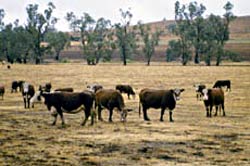
- Phase I: Pasture is very short (<three cm) and root reserves are unremarkably low. The small leafage surface area limits the amount of energy that plants can obtain from the dominicus, so growth is slow.
- Phase 2: in that location is enough leafage for plants to grow apace.
- Phase III: growth slows downwards and quality falls equally the plants mature and prepare seed.
The shorter the pasture, the longer it will stay in phase I when atmospheric condition improve. It is faux economy to delay the commencement of mitt feeding at the beginning of a drought, as this merely means that your 'dark-green drought' phase volition last longer when useful rain finally falls.
In a normal season, keeping the pasture in its agile growth phase (phase II) will maximise both pasture and beast product. At some stage, however, the pasture must be rested to allow it to mature and prepare seed, even though its quality will fall as a result.
There may be other reasons why grazing pressure is increased or decreased at specific times — for example, heavy grazing when an undesirable species is setting seed, in order to command its spread.
Continuous stocking of pastures can rarely exist recommended. Some course of controlled grazing that includes periods of spelling that are timed to coincide with specific needs of the pasture is disquisitional to productive, stable systems.
Effective nutritional direction of the herd relies on the establishment of productive stable pastures that preferably contain at least 30% of a well-adapted legume. Where possible, and depending on the enterprise and market place targets, properties should have a mix of pasture types (both native and introduced) to increase the options for grazing management.
In poor seasons, native pasture (being ameliorate adjusted to Australia'southward unreliable rainfall and poor soils) may produce more than useful feed than will introduced species, which give greater production in skilful seasons.
Using grazing management to maintain or better pasture quality has a distinct advantage over other management methods — it can cost almost nothing. If grazing management is non practised or is inadequate, more expensive inputs such equally fertiliser and herbicides, and more frequent resowing of pasture, are likely to exist required.
Effects of stocking charge per unit on pasture
At that place is no static optimum stocking rate, as carrying capacity of a property varies from season to season and from i year to the adjacent. Ideally, holding stocking rates should reverberate variation in carrying capacity through the timing of operations such equally calving and sales, and in enterprise flexibility. Direction's values and attitude to chance will of course influence the arroyo.
There are ordinarily higher returns per cow when stocking rates are low, but at that place are higher returns per hectare with college stocking rates. At excessive stocking rates, the system may crash.
If a genetic improvement plan or change of breed increases the weight of breeders in the herd, the need to change stocking density or rotation length must be recognised. For example, 100 Charolais cross cows may eat xx% more than 100 British bred cows, and and so will run out of feed sooner if no adjustments are made.
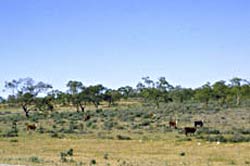
Stocking charge per unit equally applied at the paddock level, often called stocking density, is a very powerful pasture management tool. It tin be used to actively control the quality and quantity of feed on offer and the survival of desirable or undesirable plant species. For example, loftier-density grazing with dry stock might be used to remove bulky expressionless pasture in order to forestall shading of new pasture growth. (Protein supplements for the cattle may exist needed to encourage more complete utilise of low quality dry out forage, but close monitoring is necessary to forestall overgrazing. Meet the section 'Maintaining ground embrace'.)
Both low and loftier stocking rates accept the potential to essentially alter pasture composition. Unlike constitute species will respond differently to grazing pressure. Annual grasses tend to be more competitive, and they germinate and abound faster than practice perennial species. Thus if loftier stocking rates are maintained for too long a period, overgrazing may allow annuals to boss and displace perennials, resulting in a shortage of fodder outside the annuals' growing season.
It also needs to be recognised that if the overall quality of the pasture is not high, animal production will suffer if stocking charge per unit is increased to the point where selection of the higher quality pasture components is no longer possible. On the other manus, at depression stocking densities, the opportunity to select the higher quality component of the pasture may maximise animal production, but the effect over fourth dimension may be to permit the less desirable ungrazed plants to dominate. If stocking rate is not adapted, the more desirable species may exist lost, and the quality of the pasture overall will fall.
Successful/sustainable grazing management requires skill and experience. The key is flexibility — the rest period or rotation length needs to be adapted depending on pasture growth rate and seasonal weather.
Mixed farming gives greater productivity and flexibility
Pastures, particularly perennial pastures, are becoming a vital part of many cropping rotation systems, in add-on to their traditional utilize in country that is likewise marginal for cropping to be successful. Nosotros now recognise that continuous cropping of the same surface area is detrimental to soil structure, reduces soil organic matter and biodiversity, and is likely to be unsustainable unless there are extensive fertiliser inputs.
Enterprise diversification and the maintenance of biodiversity are becoming increasingly recognised as benign for the continuation of successful farming operations, partly because they allow for greater flexibility and therefore some protection from climatic and economical variability.
Systems that combine grazing and cropping enterprises more than readily allow the memory of stands of natural vegetation. Undisturbed areas of natural bushland or planted copse become a habitat for wild animals, including insectivorous birds which feed on pests such as aphids, midges, scarab beetles and heliothis caterpillars, and which provide the potential for reducing the demand for chemic applications if given the opportunity to multiply side by side to cropping lands. These undisturbed areas besides allow the survival of earthworms and the microflora and microfauna that may otherwise be destroyed in a continuous cropping organisation.
Pasture rotation can as well interrupt the life cycles of almanac weeds and other crop pests. If a legume such as lucerne is used, it tin build soil nitrogen, which will reduce the need for external fertiliser inputs. Comparison the texture and composition of undisturbed soil with the soil properties of side by side cropping country may be a valuable indicator as to whether cropping is damaging the soil.
Perennial pasture is a lower-toll and lower-risk performance than enterprises which involve cropping, especially in areas with unreliable rainfall. Benefits include:
- maintenance of basis encompass, resulting in less erosion;
- undisturbed soil, providing a habitat for the huge range of microflora and microfauna necessary for healthy soil;
- lower fuel costs than those for a cropping enterprise, which may become a more significant consideration in the future (see the section 'Minimising fuel consumption' below);
- greater water extraction from deeper soil layers, which will better combat rising watertables and resultant salinity issues.
Soil direction
Fugitive soil compaction
Soil compaction, or 'soil pugging', due to the touch on of cattle hooves, is inevitable with cattle production. The farthermost case of soil pugging is obvious, but the upshot of cattle merely treading on the plants and soil is often not appreciated. In experimental trials, using typical commercial stocking rates, yield reductions of at least 20% have resulted.
Compaction severity varies with soil type, beingness worst on wet soil that has a high clay content. Every effort should exist made to move cattle onto lighter soil when heavy rain is likely. Soil compaction results in resistance to root penetration, reduced water infiltration and reduced aeration.
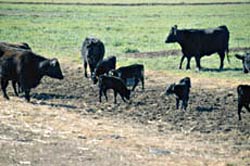
In contrast, where there are sandier soil types and/or in more arid environments, 'hoof cultivation' tin can be invaluable for burying seeds and and so helping to institute and renovate pastures.
If cattle are creating tracks, such as the route to the h2o trough, behave in mind that these can go channels for surface water flow, and may initiate more serious erosion. If this starts to occur, steps will need to exist taken to forestall it. Rotational grazing practices are likely to be the best practical means of limiting treading impairment.
In mixed-farming enterprises, it is mutual practice to graze cattle on sorghum stubble post-obit harvest. Still, the compaction that results on cropping country is probable to be more dissentious than that which results on established pasture, and will reduce the ability to use the more sustainable farming practices of reduced or 'no till' cropping. These factors should exist considered in the 'whole farm' plan. Further research is required to determine the best system in this state of affairs.
Maintaining basis cover
The amount of ground cover needed to prevent erosion varies with soil type, soil condition, location and slope. For example, enquiry has shown that, on the northern slopes of NSW, a ground embrace of at least lxx% is needed on ruby-red soils where at that place is a slope of approximately ten%. The figure of 70% ground cover is oft used equally a practiced generalisation; notwithstanding, less cover may be adequate in plains country and more cover may be necessary on steeper footing.
In one case run-off becomes excessive, less water soaks into the soil where it is needed, and pasture growth tin can be far below its potential as a issue. Excessive run-off will create erosion problems.
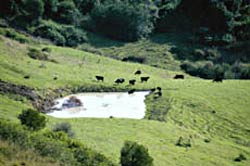
Overgrazing occurs commonly over much of Australia considering rainfall and therefore feed supplies are often erratic. These periods of short supply are a normal part of the bicycle, and then producers should either plan ahead past setting aside feed reserves to carry them through these times, or exist willing to destock.
Supplementary feeding should first before ground cover is adversely affected and before stock kickoff to lose condition, otherwise pasture growth rates will be affected. Protein or urea supplements for the cattle will allow more complete use of poor quality paddock feed, simply these tin encourage serious overgrazing (to the point where cattle eat every blade of grass in the paddock) if pasture levels are not monitored and grazing pressure is not managed properly.
In one case ground cover is getting downwardly to levels where there is an increased gamble of erosion, animals should exist removed by sale or agistment, or confined and fed a complete ration. Animals should non be allowed to continue to wander in search of scarce feed. This wastes the animals' free energy, and hence increases the amount of feed required to maintain trunk weight or condition, every bit well as increasing the risk of erosion and threatening the survival of pasture.
Fencing layout
Soil type, topography, aspect, pasture type and mob size should be taken into business relationship as much as possible when planning where fencing will be located:
- Traditional 'foursquare' paddocks may make direction more difficult if more than ane soil type, or both sloping and flat basis, are present inside the one paddock. For example, some pasture species may survive on southern slopes (which tend to be cooler and wetter) but not on northern slopes in areas marginal for their requirements.
- Different pasture growth rates due to aspect or changing soil types may demand to be managed differently.
- Land that has uniform characteristics should be fenced and managed as a unit as far as practicable.
- Several small paddocks let greater flexibility in grazing management than exercise fewer larger paddocks.
- In mixed-farming situations, it may be worth constructing temporary electric fencing, which volition help to reduce fencing costs.
Yard location
It is essential to consider soil type and drainage when choosing a site for new yards. Heavy dirt soils bog upwardly in wet weather and are slow to dry out out. Light sandy soils may permit effluent to percolate down and pollute hole-and-corner watertables; they as well tend to exist very dusty in dry conditions. If possible, choose a site that has loamy well-drained soil.
Where cattle are to be confined for prolonged periods, for case during yard weaning, it is preferable to accept a layer of clay beneath the surface to limit move of effluent into hush-hush watertables.
Water direction
Good quality water is perhaps the scarcest resources on this continent, and needs to be utilised as efficiently as possible. Availability of watering points volition influence paddock layout, and may limit the amount of subdivision possible on a grazing belongings. If watering points are too far autonomously, cattle will overgraze close to water and undergraze the rest of the paddock. Cattle that have to walk long distances to reach water will waste matter energy and make slower weight gains.
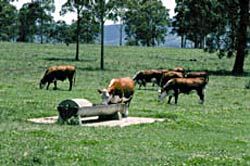
Provide h2o in troughs or ground tanks rather than allowing free access to watercourses. Cattle using natural streams tend to erode stream banks and foul water, leading to sedimentation and pollution, and perchance algal blooms downstream. If you cannot provide h2o in troughs, limit access to stream water to the within of bends, where the erosion potential is less.
Inquiry has shown that fifty-fifty if a watercourse is not fenced, cattle will prefer to beverage at a trough if one is provided on their normal route to h2o. This information is useful, particularly if funds are not available for fencing. (Note: Funds are often available for such projects through Landcare groups or government natural resource management programs.)
Fenced riparian zone (river banking company) areas can be used as a drought reserve, or grazed for brusque periods in a grazing rotation in social club to control weeds. For information on managing stock in riparian zones, come across the publication Managing Stock (Issue Sail half dozen), which is role of the River Landscapes website, published by Land and Water Commonwealth of australia.
Information technology is as well preferable to fence off dams and to piping dam water to troughs, considering cattle volition foul dams and reduce water quality, especially when the supply is low. Research has shown that animate being performance is affected by foul water, presumably considering animals that drink less will also eat less.
Fertiliser run-off
Intendance must be taken when using fertiliser to ensure that information technology does not contaminate watercourses. The spreading of fertiliser over or near watercourses or bare sloping state (which may exist subject to run-off during intense summertime storms) should be avoided.
Air management
Minimising greenhouse gas emissions
Cattle and sheep contribute an estimated x.8% of Australia's greenhouse gas emissions, mainly every bit methane and carbon dioxide. On average, cattle produce an estimated 49 kg methyl hydride per head per year.
Methyl hydride is produced past microbes in the rumen. This is an undesirable loss to the animate being, as information technology represents a loss of energy, part of the feed that the animal has failed to employ. The coarser and more fibrous the feed, the greater the proportion of digested energy that is lost as marsh gas. Pasture with loftier digestibility is more efficiently utilised. (For more information on the digestibility of pasture, see the Primefact Pasture cess and livestock product.)
Several state and federal research teams are currently attempting to reduce methane production from ruminants by selectively altering the microflora and microfauna of the rumen population. Some reduction in methane production may be possible, but it is unlikely that ruminant emissions will ever be methane-complimentary.
Nigh beefiness producers already aim to finish cattle as young as possible, in an attempt to improve meat quality and obtain a better price. An fauna that reaches slaughter weight three months earlier than others will produce less marsh gas in its lifetime, and hence less methane per kilogram of product. Thus by managing pasture to maintain high digestibility, and by selecting for more feed-efficient cattle and rapid growth, producers are already helping to reduce the greenhouse gases emitted from their herds!
Minimising fuel consumption
The burning of fossil fuels is a major source of greenhouse gases, and this fuel is also a non-renewable resources. The full consumption of resources in producing our nutrient is an increasingly important factor to be considered in the future. Australian pasture-fed beef production is a relatively fuel-efficient arrangement when compared with grain-fed beef production. The fuel costs, including environmental costs, involved in working the soil, sowing seed, and harvesting and transporting the grain are all avoided by raising cattle solely on pasture.
Fuel costs will rise essentially equally readily attainable fuel reserves become depleted. The demand for fuel will continue to increase with the expansion of the human population. In the future nosotros may not exist able to waste scarce fuel supplies on growing grain for cattle — the energy cost will exist too high. Nosotros will demand to feed all the grain directly to humans.
This long-term view must be kept in mind before any 'improvements' involving high fuel usage are contemplated. Introduced pasture in marginal areas may not be economical if frequent re-sowing is necessary. Systems that require the least fuel will be more sustainable in the long term. The value of minimal intervention, possibly by fertilising existing native pasture, may well come into its own in the next decade.
Stock management
Disease and pest management
Affliction control is a normal function of adept farm management. Some diseases should be controlled by vaccination, for instance leptospirosis and vibriosis. For other diseases where controls are in place for market access, for example Johne'due south disease (JD), producers need to have intendance to bide past legal requirements for merchandise between different JD zones of the land.
Disease control is essential not simply to better the productivity of your own enterprise, but also to minimise the possibility of adversely affecting your neighbours' production. Fences should be kept in good club, and bulls in particular should be prevented from straying, to avert the possibility of illness spread between your stock and your neighbours' stock. Similarly, feral animals which may spread disease, such as pigs, should exist controlled.
Weed control should also be undertaken in gild to forestall deterioration of your pasture (and your neighbours' pastures, to which the seed from your pasture may spread).
Taking responsibility for animal welfare
The Prevention of Cruelty to Animals Human activity 1979 states that 'A person in accuse of an animal shall not fail to provide food, drink or shelter ...'. It is non acceptable for animal owners to leave the animals in their care to fend for themselves during drought, extreme cold, stress or natural disasters, since in confining their animals they have limited the animals' power to take steps to help themselves.
The vast majority of people hold this attitude towards animals in their intendance. Pressure from the broader community must be brought to impact the few who do not, and who are bringing the whole industry into disrepute. If you know someone who is allowing animals to starve or is otherwise neglecting the welfare of their animals, say something to them about it. If zippo is washed to right the situation, report it to the RSPCA or police.
Absentee stockowners take had disastrous losses from bloat, considering pasture conditions have changed without their knowledge. This is as much a welfare issue as is a lack of feed or water. Arrangements should be fabricated to accept cattle and paddock conditions inspected regularly past someone living locally.
Standards and Guidelines
The Australian Creature Welfare Standards and Guidelines for Cattle are available, and these are recommended reading. In many ways, guidelines tin exist regarded as 'best practice' manuals. They can provide useful information; for example, they set out the space required per head of cattle when hand feeding in yards. Guidelines at present take some legal standing, in that failure to comply with function of a guideline can be used as bear witness, usually in cases involving breaches of the Prevention of Cruelty to Animals Act 1979.
Minimising painful procedures
Animals have a right to be treated humanely and thoughtfully. In the past some painful direction procedures have been condoned considering in that location was no applied culling. This is no longer the example. Producers should exist looking for ways of reducing stress and pain in their animals as much every bit possible.
Animals have a right to be treated humanely and thoughtfully. In the by some painful direction procedures have been condoned because there was no applied alternative. This is no longer the case. Producers should be looking for ways of reducing stress and hurting in their animals every bit much every bit possible.
Information technology should not be assumed that just because something has always been done a certain way in the by, that it is right! Ask yourself whether the hurting and stress that you inflict upon cattle can be reduced. Is the procedure really necessary? Many producers have stopped branding cattle, as the standard of fencing has improved, and culling methods of identification are becoming more widespread.
In many breeds, polled bulls can be used to eliminate the need to dehorn. If this is not an option, there are several methods of dehorning very young calves which are less traumatic than traditional methods.
Low stress handling
Awareness of the flight zone around cattle is essential to minimise stress. Usually the flight distance is about 2–3 body lengths, merely this will vary depending on an fauna's past feel with humans. If this space is invaded, cattle volition endeavour to escape. While working cattle in yards, it is best not to invade this space until it is actually required.
Where you stand is critical to where the cattle will move. In that location is a point of residue, about level with the shoulder, where the brute will motion neither forwards nor backwards if approached. If the animate being is approached from in front of this point, it volition go backwards; if it is approached from slightly backside the shoulder, it will go forwards. For most experienced stockworkers, the use of the point of balance in this mode is second nature.
Most producers choose animals that take an ambitious temperament, but it is also important to choose excessively timid, panicky animals. Research has shown that these timid animals (in contrast to aggressive ones) often perform poorly in feedlots. They are also likely to exist the ones that use up musculus glycogen and bruise themselves because they panic during loading and transport. This in turn results in dark, poor quality meat.
Aggressive animals may cause bruising in others, or 'stir upwards' during handling, with similar effects on meat quality as those that occur in the panicky cattle.
Consider natural behaviour in g design
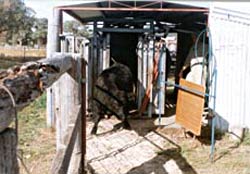
The design of yards, including the fashion they face in relation to the dominicus, and the direction of gradient, is extremely important. If cattle will not move freely through your yards, accept a serious look at the yard design earlier reaching for the electrical prodder!
Natural animal behaviour should be taken into account in the positioning of yards; for instance, cattle prefer to run uphill and towards the light. They tend to baulk at nighttime shadows (come across Figure 8). Cattle may work well in the morning but not in the afternoon considering of the change in shadow distribution. The timing of husbandry operations may demand to be planned appropriately. Including these considerations at the planning stage will make handling easier, and improve stock (and operator) welfare.
Provision of shade and shelter
In the past, trees have been seen as occupying space and taking up h2o and nutrients that would otherwise grow more grass to feed more cattle. This mental attitude has left us with a legacy of rising watertables leading to salinisation of large tracts of country, and increased levels of soil erosion.
The shade and shelter provided by copse and shrubs often more than compensates for the loss of available surface area for growing grass. An animal's energy requirements may more than than double in cold weather, merely to maintain the creature's body oestrus. (In general, the smaller the fauna, the greater the increment in requirement.) Shelter tin reduce this requirement for extra feed by providing a warmer microclimate downwind of the shelter. It also improves the survival charge per unit and welfare of newborn animals during adverse weather conditions.
CSIRO enquiry has shown that during periods of cold stress, shelter increases both temperature and humidity, with the largest increase at a distance of virtually five windbreak heights from the windbreak, merely this extends to a distance of nearly twelve windbreak heights downwind. That is, a much larger area benefits from the protection than is adversely afflicted past competition for water and nutrients in the root zone of the windbreak trees.
At the other farthermost, cattle in hot climates are likely to have a lower water requirement if they are provided with shade. Provision of shade may maintain soil wet and extend the period of grazing available from more productive species of pasture plants that take been planted where their rainfall requirements are barely met. Clovers survive for longer in the shade, where they are protected from heat and moisture stress.
Responsible use of chemicals
ALWAYS READ THE Label
Users of agricultural (or veterinary) chemical products must e'er read the characterization and any Allow before using the product, and strictly comply with the directions on the label and the conditions of whatsoever Permit. Users are non absolved from compliance with the directions on the characterization or the atmospheric condition of the Permit by reason of whatever argument made or not made in this publication.
Information technology is the responsibility of everyone who uses chemicals to ensure that chemical residues practise not remain. While zero contamination of produce at all times is an unrealistic expectation, the public ofttimes does not distinguish between acceptable residue levels, which are well below those that pose any threat to human being wellness, and unacceptable levels, which are a real concern. To a growing number of consumers, the presence of any chemical whatsoever is perceived as unacceptable, if non dangerous. Whether justified or not, these concerns must be taken seriously, as they can greatly influence markets. Thus there are 2 bug involved in the command of residues: condom and quality balls.
Avoiding residues
When applying any chemicals or other treatments to animals, they should exist weighed to ensure that the correct dose is administered. Practiced records must be kept to show which animals are treated and when they are treated, so that withholding periods (WHPs) can be observed. If cattle are to go for export, then the export slaughter interval (ESI) must also be observed. The ESI may be several times longer than the WHP.
Land that is to be used for grazing cattle should be checked for its previous uses. If persistent chemicals such as organochlorines are suspected to take been used, then soil samples should exist sent for analysis. The ground effectually old dip sites or similar areas should also be sampled or should be fenced off from livestock.
During drought, the risk of unacceptable residues increases. Reasons for this include increased ingestion of contaminated soil when grazing shut to the ground, and feeding of unusual feeds, especially if these are not unremarkably fed to stock (e.g. sugar cane, grape marking, and, in the past, cotton trash, which is now non supplied equally stockfeed), as these may have had chemicals applied to them.
Whatsoever chemic contaminant in feed, if present in sufficient concentration, can cause unacceptable residues in livestock products. When purchasing any feed, the purchaser should inform the seller of the feed's intended use, and ask if whatsoever chemicals have been applied to the feed, or if there may be whatsoever other sources of residues. Vendor declarations, such equally the one required by the Australian Lot Feeders' Clan, should always be sought. If in dubiousness, the feed should be either tested or not purchased.
Cattlecare, the beef manufacture's on-farm quality assurance system, requires written statements on purchased stockfeeds regarding chemical usage during the product of the feed. (For further information on residuum risks in drought, see the Primefact Drought increases residue risks.)
The time taken to articulate residues from animal tissues varies greatly, depending on factors such equally:
- the chemic involved
- the level of intake
- the duration of feeding
- the changes in the fauna's torso weight and condition.
If it is suspected that animals may have been exposed to chemicals, information technology is preferable to have biopsy samples taken by a veterinarian and tested for residues, rather than chance having the animal(s) condemned at slaughter and placing market admission at gamble.
Various programs are in place to minimise the risk of residues in meat products. These include:
- NORM - National Organochlorine Residue Direction plan
- NARM - National Antibacterial Residue Minimisation program.
Unintended victims - dung beetles, other native insects, microflora
While WHPs are designed to avoid unintentional exposure of humans to chemicals, in that location may be other victims non afforded this protection! There is growing awareness that chemicals we employ to control lice and worms in cattle can touch dung beetles and other insects.
Myriad tiny animals contribute to the maintenance of soil fertility and structure. If their numbers are significantly reduced, then soil quality, pasture and therefore animal production are all probable to endure. Recycling and burial of the nutrients in dung past dung beetles may significantly reduce wing problems in sheep and cattle enterprises, and distributes this natural fertiliser more completely through the soil.
For further information on dung beetles, come across the Primefact Dung beetles - working for you.
Antibiotic resistance in humans
There is growing show that the use of some antibiotics in animals can pb to the development of resistant strains of the bacteria that tin affect humans. The fact that veterinarians are required past law to prescribe S4 drugs just for specific conditions is an endeavour to reduce the inappropriate use of antibiotics, and so reduce the risk of resistance developing.
Also of importance is the more firsthand threat of the development of resistant animal pathogens. If at all possible, animals should be accurately weighed before they are treated with antibiotics. If only an judge is made of the weight of an animal, and the guess is inaccurate, and then underdosing or overdosing will occur. Underdosing or not completing the full course of antibiotics may atomic number 82 to the survival of a few of the most resistant individuals. These will then multiply, and the normal population will become more resistant to the antibiotic used. Many bacteria have the ability to bandy genes, thereby conferring resistance to antibiotics with other leaner. Overdosing may lead to toxicity problems, especially in young animals.
The total course of antibiotics must be completed, even if the animal appears to have already recovered.
The use of low doses of selective antibiotics (eastward.chiliad. Rumensin®, Lascalocid®, Avoparcin® and Eskalin®, which are used to modify rumen function) is known to increase antibiotic resistance in gut flora. On the other hand, their use leads to greater rumen efficiency, less methane product and faster growth rates, which is environmentally friendly.
Resistance to glycopeptide antibiotics such as vancomycin is becoming more than widespread in humans, and in that location is prove that this is due at to the lowest degree in office to the employ of Avoparcin®, also a glycopeptide, in animate being feeds.
Producers must ensure that any antibiotics used for their livestock are admittedly necessary and are given at the correct dose rate, and that WHPs and ESIs are observed.
Belongings management planning - matching the enterprise to the resource available
Property management planning involves planning the efficient, integrated utilize of all resources, including human being and financial resource as well every bit the physical resources. It involves the consideration and integration of the many factors that are discussed beneath. Property management planning is an ongoing process, and it assists producers to improve their profitability and reach more than sustainable natural resource use. Producers and their families should identify their personal and business organisation objectives and so develop plans to accomplish those objectives. Monitoring is an important function of this planning process.
More information on holding management planning is available through CB Alexander Agronomical College ('Tocal'), or by contacting your local LLS role.
This Agfact focuses on the responsible use of physical resources. Cartoon upward a physical farm programme will assist with forwards planning and clarifying priorities, so that the more of import changes are made first. Information technology may be necessary to modify the established layouts of some backdrop so that environmental factors and beast behaviour can be taken into business relationship, now that these are better understood.
The farm should also be looked at in the context of the surrounding country, and possibly on a total catchment ground. Sometimes, changes to fencing or the position of contour banks, or changes to other aspects of the property, are improve planned in conjunction with neighbours. This helps to ensure that what is done on ane farm does not adversely impact side by side belongings or those further down the catchment. Courses designed to help y'all describe upward a farm plan are available through CB Alexander Agricultural Higher ('Tocal').
The enterprise mix chosen must be matched to the local environment. It may exist more cost-effective to modify your breed of cattle (or to cross brood) to a blazon that can effectively use the forage that your land can economically produce, rather than trying to produce feed to back up a detail breed of cattle. Some breeds do meliorate than others in tougher environments. For example, larger framed European breeds are harder to support on marginal country or where rainfall is unreliable. On the other mitt, information technology is of import to ensure that the cattle–pasture interaction is sustainable. For case, some Bos indicus cattle might overgraze some species of desert plants that Bos taurus cattle would graze only sparingly.
Non all pastures are suited to finishing cattle. You must accept a specific market place in heed which your cattle and other resource are capable of meeting, and then that yous can plan ahead to run across the specifications of that market. Long-term survival of an enterprise is unlikely for producers who simply grow out the cattle and then try to find a market which suits them.
Risk direction and enterprise flexibility
Farming in the Australian climate is a high-risk enterprise. It is prudent to assume that most years volition take less than ideal conditions, and to programme accordingly by conserving forage to 'tide you over'. A plan of action in the issue of persisting drought conditions should be worked out in accelerate. Brand some rules about which stock would exist sold first, and what the trigger would exist for this action. (For more information on coping with the adverse weather condition caused by drought, see the Drought department of the website.)
It is preferable for at that place to be flexibility in the blazon of stock run, and so that stock can be finished as vealers, yearling steers or Jap ox, depending on the availability of feed and which markets offer the best returns. Very early or very late maturing cattle tend to limit this flexibility.
Monitoring and record keeping
A good tape-keeping system on the subcontract is essential. Only then will you be able to appraise whether your subcontract plan is working, and whether the enterprise is financially and environmentally sustainable. Often, trends are apparent merely when a continuous tape over several years has been kept.
Most farmers are familiar with the concepts of keeping records in relation to enterprise productivity and subcontract finances. Even so, with the growing awareness of environmental problems and the fragility of the natural resource base, it has become increasingly apparent that the affect of agriculture on the surround should also be monitored in gild to assess the sustainability of an agricultural enterprise.
Monitoring financial and productivity performance
Many producers keep a variety of records, then fail to utilize them fully. There are now many splendid figurer programs which solve this problem by making calculations easy and enabling much more thorough assessment of productivity and business organization performance.
Aspects that can be monitored include:
- cows joined, pregnancy test results, and calves built-in, marked and weaned;
- breeding records, and then that poor performers can be identified and culled, and the progeny of unlike bulls tin can exist compared. (Private identification of cattle, then that these sorts of records can be kept, is strongly recommended);
- growth rates, so that genetic merit or feeding regimes tin can exist compared;
- cattle numbers bought and sold;
- sale age, weight and price;
- production per hectare ('total weight of animals sold' divided by 'total hectares grazed');
- meat income per grazing hectare ('proceeds from animals sold' divided by 'full hectares grazed');
- any health problems in stock, crops and pasture;
- treatments (e.grand. antibiotics, and lice and worm treatments), the dates these were administered to animals, whatever withholding periods (WHPs) or export slaughter intervals (ESIs), and the results of treatment;
- paddock records, pasture growth, ground cover, dates stock went in and out etc.;
- dates of fertiliser or weedicide applications, insecticide sprays etc., and any WHPs;
- all costs, including treatment costs for animals, costs of crops and pasture, sowing costs, machinery maintenance costs, selling costs etc. (Allocate all costs separately to unlike components of a mixed-farming enterprise so that you can cheque that each component is paying its way. For instance, calculate fuel and machinery costs associated with sowing grazing oats separately from the costs involved with whatsoever cropping enterprise, since the grazing oats are part of the cattle enterprise.);
- water use, water quality etc.
Monitoring the condition of natural resources
Obtaining a measure of a farm's ecology sustainability is non straightforward, but there is some relatively elementary monitoring that can be undertaken which will provide you lot with a guide as to the health of your farm'southward natural resource.
With environmental monitoring, it is very important to monitor over a menstruum of fourth dimension in social club to detect a trend or modify. Useful monitoring would include the following:
- Regular soil tests will give an indication of declining soil fertility or if soil acidity bug are developing.
- Where salinity is a potential problem, monitoring groundwater levels will assess progress or otherwise of the steps being taken to reduce the watertable level.
- The health of areas of native vegetation and the presence or absence of native animate being should be assessed. A range of species and of ages of species will improve the health of native vegetation and will also promote the presence of native beast.
- The health and multifariousness of vegetation on and within stream banks should be assessed.
- Observation of wildlife may give some indication as to whether the areas that have been set aside for copse and other native vegetation are large enough.
- Monitoring the percentage ground cover (and pasture limerick) will give an indication of erosion risk.
- For irrigation development, h2o use efficiency should be monitored and compared confronting benchmark levels. H2o use efficiency that is below criterion levels indicates water losses to the surround.
For specific areas of interest, it is a good idea to have photos in the same location in successive years to provide a pictorial record of alter over time. This is particularly useful in the monitoring of change in native vegetation health, state degradation, and the response to management practices that accept been instigated to ameliorate country degradation problems.
Conclusion
To run a sustainable enterprise, producers demand to:
- have a farm programme which includes articulate business goals;
- ensure the enterprise is economically feasible;
- actively seek, interpret and apply advice and new information;
- have flexible management strategies to see variations in climate and markets;
- ensure that their product meets market requirements;
- ensure that their product organization meets consumer expectations in terms of animate being welfare and demonstrated intendance for the environment;
- have no visible signs of land deposition on their belongings (or, if at that place are signs, be in the procedure of reversing any land degradation that has occurred);
- conserve areas of native vegetation on their property.
The producer'due south aim should be the profitable production, in the virtually humane and efficient way possible (all-time management practice), of a safety, consistent, high quality product, while maintaining or enhancing the quality of resources and conserving the natural environment.
Most beefiness producers would not knowingly do anything that would degrade the resources on which their livelihoods depend. Just not everyone is enlightened of the possible long-term consequences of some direction practices that were adult before nosotros fully appreciated many of the issues raised above. For an agricultural system to exist sustainable, it likewise needs to be adaptable and to be prepared for change.
However, responsible, sustainable beef production need non exist a daunting task. In many cases, there may exist very lilliputian that needs to exist changed, just the before the demand for change is recognised, the improve. The intention of the data in this Agfact is to increase awareness of all the issues involved, so that future management plans can take account of them. The well-nigh successful and assisting beefiness production system will exist i that is fully in tune with the environment and order's expectations.
montanezspither90.blogspot.com
Source: https://www.dpi.nsw.gov.au/animals-and-livestock/beef-cattle/husbandry/general-management/production
0 Response to "How to Make Beef Production Better on the Environment"
Post a Comment