Art Recycyling Trash Fashion December 2015 Spanish River High
Updated | Visitors who stepped into mode retailer H&1000's showroom in New York City on April 4, 2016, were confronted past a pile of cast-off habiliment reaching to the ceiling. A T.Due south. Eliot quote stenciled on the wall ("In my finish is my beginning") gave the showroom the air of an art gallery or museum. In the next room, reporters and style bloggers sipped wine while studying the half-dozen mannequins wearing bespoke creations pieced together from one-time jeans, patches of jackets and cut-upwards blouses.
This cocktail party was to celebrate the launch of H&M's nigh contempo Conscious Drove. The actress Olivia Wilde, spokeswoman and model for H&M'due south forays into sustainable fashion, was there wearing a new dress from the line. But the fast-fashion behemothic, which has almost four,000 stores worldwide and earned over $25 billion in sales in 2015, wanted participants to also accept detect of its latest initiative: getting customers to recycle their clothes. Or, rather, convincing them to bring in their onetime dress (from any brand) and put them in bins in H&1000's stores worldwide. "H&1000 will recycle them and create new textile fibre, and in return you get vouchers to use at H&M. Everybody wins!" H&M said on its blog.
It'south a nice sentiment, but it's a gross oversimplification. Simply 0.1 percent of all wearable collected past charities and take-dorsum programs is recycled into new textile fiber, according to H&M'southward development sustainability managing director, Henrik Lampa, who was at the cocktail political party answering questions from the press. And despite the impressive amount of marketing dollars the company pumped into Globe Recycle Week to promote the idea of recycling apparel—including the funding of a music video by 1000.I.A.—what H&M is doing is naught special. Its salvaged wear goes through almost the exact same process as garments donated to, say, Goodwill, or actually anywhere else.
Moving picture yourself with a trash bag of old wearing apparel you've just cleaned out of your cupboard. You call back y'all could get some money out of them, so you have them to a consignment or austerity shop, or sell them via ane of the new online equivalents, like ThredUp. But they'll probably refuse nearly of your old dress, even the ones you paid dearly for, because of small flaws or no longer being in flavour. With fast way speeding up trends and shortening seasons, your clothing is quite probable dated if it'south more a year old. Many secondhand stores volition reject items from fast-manner chains similar Forever 21, H&Thou, Zara and Topshop. The inexpensive habiliment is poor quality, with low resale value, and there's but too much of information technology.
If you're an American, your next step is likely to throw those sometime clothes in the trash. Co-ordinate to the Environmental Protection Agency (EPA), 84 percent of unwanted clothes in the United States in 2012 went into either a landfill or an incinerator.
When natural fibers, similar cotton wool, linen and silk, or semi-synthetic fibers created from plant-based cellulose, like rayon, Tencel and modal, are buried in a landfill, in 1 sense they act like food waste, producing the strong greenhouse gas methane as they dethrone. Merely dissimilar banana peels, yous tin can't compost old wearing apparel, even if they're made of natural materials. "Natural fibers go through a lot of unnatural processes on their way to becoming clothing," says Jason Kibbey, CEO of the Sustainable Dress Coalition. "They've been bleached, dyed, printed on, scoured in chemical baths." Those chemicals can leach from the textiles and—in improperly sealed landfills—into groundwater. Burning the items in incinerators can release those toxins into the air.
Meanwhile, synthetic fibers, similar polyester, nylon and acrylic, have the same environmental drawbacks, and considering they are essentially a type of plastic fabricated from petroleum, they volition accept hundreds of years, if not a thousand, to biodegrade.
Despite these ugly statistics, Americans are blithely trashing more apparel than ever. In less than 20 years, the volume of clothing Americans toss each year has doubled from 7 million to 14 million tons, or an astounding lxxx pounds per person. The EPA estimates that diverting all of those often-toxic trashed textiles into a recycling program would exist the environmental equivalent of taking vii.3 million cars and their carbon dioxide emissions off the route.
Trashing the clothes is as well a huge waste matter of coin. Nationwide, a municipality pays $45 per ton of waste sent to a landfill. It costs New York City $20.6 million annually to transport textiles to landfills and incinerators—a major reason it has go especially interested in diverting unwanted clothing out of the waste matter stream. The Department of Sanitation'south Re-FashioNYC program, for example, provides large collection bins to buildings with 10 or more units. Housing Works (a New York–based nonprofit that operates used-wearable stores to fund AIDS and homelessness programs) receives the goods, paying Re-FashioNYC for each ton collected, which in turn puts the coin toward more bins. Since information technology launched in 2011, the program has diverted 6.4 million pounds of textiles from landfills, and Housing Works has opened up several new secondhand clothing sales locations.
But that'due south only 0.3 percent of the 200,000 tons of textiles going to the dump every year from the metropolis. Just 690 out of the estimated 35,000 or so qualified buildings in the metropolis participate.
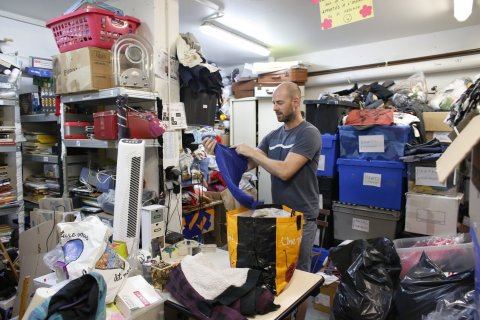
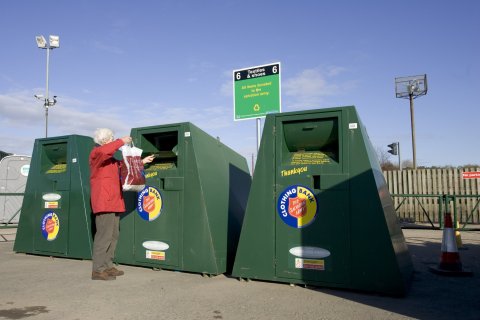
Smaller municipalities have tried curbside collection programs, simply almost go underpublicized and unused. The best bet in most places is to have your old wearable to a clemency. Booty your bag to the back door of Goodwill, the Salvation Army or a smaller local shop, become a tax receipt and congratulate yourself on your largess. The clothes are out of your life and off your mind. But their long, international journeying may be just beginning.

Fabricated to Not Terminal
Co-ordinate to the Council for Textile Recycling, charities overall sell only 20 per centum of the clothing donated to them at their retail outlets. All the big charities I contacted asserted that they sell more than that—30 pct at Goodwill, 45 to 75 per centum at the Salvation Army and 40 percentage at Housing Works, to requite a few examples. This disparity is probably because, unlike small charity shops, these larger organizations accept well-adult systems for processing clothing. If items don't sell in the master retail shop, they tin can send them to their outlets, where customers can walk out with a pocketbook full of wearable for simply a few dollars. But even at that laughably inexpensive price, they can't sell everything.
"When it doesn't sell in the store, or online, or outlets, we have to do something with it," says Michael Meyer, vice president of donated appurtenances retail and marketing for Goodwill Industries International. So Goodwill—and others—"bale upwards" the remaining unwanted article of clothing into shrink-wrapped cubes taller than a person and sell them to textile recyclers.
This outrages people who believe the function of thrift shop charities is to transfer clothes to the needy. "What Really Happens to Your Clothing Donations?" read a Fashionista headline before this yr. The story hinted, "Allow'southward just say they're not all going towards a adept cause."
"People like to feel similar they are doing something good, and the problem they run into in a country such as the U.S. is that we don't have people who need [clothes] on the scale at which nosotros are producing," says Pietra Rivoli, a professor of economics at Georgetown University. The nonprofit Due north Street Village in Washington, D.C., which provides services to homeless and low-income women, says in its wish list that "due to overwhelming support," it tin't accept any clothing, with the exception of a few especially useful and hard-to-come-by items similar bras and rain ponchos.
Fast fashion is forcing charities to procedure larger amounts of garments in less time to get the aforementioned amount of revenue—like an even more down-market fast-style retailer. "We need to go through more and more than donations to find those smashing pieces, which can make information technology more plush to find those pieces and get them to customers," says David Raper, senior vice president of business enterprises at Housing Works. Goodwill'southward strategy is much the same, says Meyer: "If I can get more fresh product more than chop-chop on the flooring, I can excerpt more than value."
This strategy—advertising new product on a weekly basis—is remarkably like to that of Castilian fast-fashion retailer Zara, which upended the entire fashion game by restocking new designs twice a week instead of once or twice a season. And and so clothing moves through the system faster and faster, seeking somebody, anybody, who will pay a few cents for information technology.
Secondhand Africa
If you donate your wearable anywhere in the New York City area and the items aren't sold at a secondhand shop, they're likely to end up at Trans-Americas Trading Co. Workers at this large warehouse in Clifton, New Jersey, receive and process about 80,000 pounds of wear a mean solar day.
When Eric Stubin, owner of Trans-Americas, president of the Council for Fabric Recycling and president of the Secondary Materials and Recycled Textiles Association, takes me on a bout of the warehouse, he pauses while a forklift scurries effectually the corner with a bale of garments and neatly stacks it in a tall, dense wall of clothing, before shooting dorsum effectually the corner to grab another from a semi that's backed up to the loading bay. Workers stand in forepart of conveyor belts making carve up-2nd assessments every bit they mine the castoffs for valuable pieces. Sometimes, they find a precious stone—a pair of vintage Levi's, an ugly Christmas sweater, an army jacket—and toss information technology into a small-scale bin full of other covetable items, which Trans-Americas tin sell at a markup to vintage stores in Brooklyn. But that's only about 2 percent of what they get. The rest is sorted into broad categories, like T-shirts, pants or cold-weather items, then divided over again by quality and cloth.
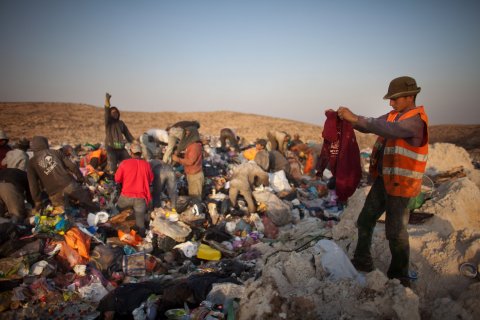
40 pct of the habiliment will exist baled and shipped all over the globe to be resold equally is. Nippon gets the second nicest vintage items later the U.Southward. stores, Due south American countries become the mid-form stuff, Eastern European countries go the cold-weather clothes, and African countries get the low-grade stuff no one else will accept. In the 1980s, secondhand clothing began flowing into African countries that had dropped their protectionist economic policies. And because it was cheaper and seen every bit higher quality than domestically produced clothing, it dominated the market. By 2004, 81 pct of clothing purchased in Uganda was secondhand. In 2005, according to an Oxfam report, secondhand article of clothing made up one-half of the volume of wearable imports in sub-Saharan Africa. As a result, starting in the 1990s, textile industries in those African countries cratered.
Early last yr, at a height of E African heads of country, some of the regional leaders proposed a ban on the importation of secondhand wear; English-speaking news sites such as Voices of Africa and CNN followed upward by positing that quondam clothing from the U.K. and U.S. was creating a post-colonial economic mess. "Exporting depression-quality clothing that has no value in our own social club forges a relationship of dependency," says Andrew Brooks at Kings College London. "You tin can phone call me idealistic, merely I don't really want to live in a world where people who are in the global south, the only clothes they can beget to buy are dress you lot and I don't want."
Not everyone agrees. Georgetown University'due south Rivoli, for case, says the secondhand vesture trade creates jobs in not only selling but also cleaning, repairing and tailoring. Karen Tranberg Hansen, an anthropologist at Northwestern University, has argued that secondhand clothing in countries like Kenya, Zambia, Kingdom of lesotho and Uganda fills a different niche than the material industry. "There are different segments of the population that have different desires," she says. "It is not a straight competition." Secondhand wearable, traditional clothing that is made locally, Asian imports—unlike people buy different things, she asserts.
Simply what everyone agrees on is that Africans buy cast-off clothing from the U.Southward. because they see it equally loftier quality and good value. This might not be truthful much longer. The 2005 Oxfam study plant that in Kenya up to a quarter of clothing in imported secondhand bales was unsalable due to poor quality. Since so, fast fashion'south market share has expanded, even as it has become synonymous with "falls apart later on two wears" for Western consumers. It's possible that Africans might somewhen recognize that the secondhand mode is merely cheap, erstwhile imported wear from Asia that fabricated a quick pit terminate in the U.K. and U.S. And like Americans, they might determine to just buy it new.
On the Brink of Plummet
Thirty percent of the clothing that comes into Trans-Americas is T-shirts and polos that will exist cut into wiping rags for machine shops and other industrial uses. Another xx percentage of the wearable—the ripped and stained items—volition be shipped out to processors that will chop it up into "shoddy," to be used in building insulation or carpet padding or floor mats for the auto manufacture. These are the to the lowest degree profitable types of wear recycling for Trans-Americas.
The surge of fast-fashion garments poses a problem for Trans-Americas too. "More garments are made with polyester [or] poly-cotton blend," Stubin says. "If yous have clothing that is lower quality, you're going to terminate up with more than wiping rags and more than fabric for the cobweb market. The market for cobweb is pennies these days. Half of the article of clothing nosotros sell for less than the acquisition value."
Though it'southward better to downcycle dress—turn them into less valuable consumer goods similar auto-shop rags—than to send them direct to the landfill, it's not a complete solution. Those rags will still find their manner to the landfill later a few uses; insulation will exist thrown in the dumpster when it's torn out of a wall or erstwhile car. Everything is cleaved down further and further until it eventually reaches the landfill.
The cost to the planet isn't just what the stuff does when it's put in the ground, though that's bad enough. The wasted resources it took to create a textile are devastating for the planet. "When information technology ends upwardly in the landfill, information technology'southward a wasted material," says Annie Gullingsrud of the Cradle to Cradle Products Innovation Constitute. "At that place'southward been an expense to the planet. In that location's been an expense to the company [and] sometimes to the people creating the materials. And it creates a need to utilize virgin materials."
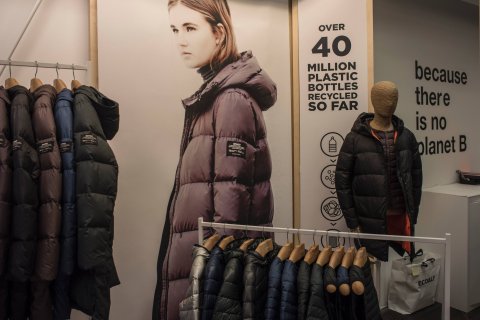
International companies like Adidas, Levi's, Nike and H&M don't want you to stop buying their products, but they also don't desire to give upwardly on their fast-style business models. "The holy grail for sustainability in mode is closed-loop sourcing," Marie-Claire Daveu of the global luxury holding visitor Kering told Vogue. (Kering owns companies like Gucci, Alexander McQueen, Saint Laurent and Stella McCartney, amid many others.) "Reuse one-time materials. Make new materials out of old materials. Recapture the fibers."
Closed-loop technology, where a product is recycled back into almost the same production, is a tantalizing prospect for sustainability advocates, considering information technology substantially mimics the natural procedure of life. A establish grows out of dirt, dies, is incorporated dorsum into dirt, and then another found grows from that dirt. Pelting falls, moves through the wood and into a river, flows to the bounding main, evaporates into the sky and falls again. There'due south no waste. If closed-loop engineering could be achieved for fashion, nothing would e'er get the landfill—it would just be incessantly looped through material factories, garment factories, stores, your cupboard, secondhand retailers, textile recyclers and dorsum to textile factories once more. Polyester thread would be created, woven into a textile, made into a garment, broken down into pure polyester and woven into a textile once again. Aforementioned for natural fibers.
But commercially scalable, closed-loop textile recycling engineering science is nonetheless five to 10 years away, at all-time. According to a 2014 study commissioned by the Sustainable Apparel Coalition, at that place is airtight-loop engineering for pure cotton that could accept a garment, interruption information technology down and reweave—but once cotton is dyed, treated or blended with other materials, the process no longer works. Treated cotton, linen, silk and wool tin can be mechanically chopped up for recycling, only they yield a low-quality, short fiber that must be mixed with virgin fiber for clothing. At xx percent reused cotton wool, H&M's recycled denim line released last summer pushed the limits of what's possible today—a higher percentage of recycled cotton results in a lower-quality fabric that tears too easily to exist clothing.
A hopeful note appeared in May when Levi's debuted a paradigm of jeans in partnership with the material technology startup Evrnu, made with a mix of virgin and chemically recycled cotton from old T-shirts. Evrnu says its engineering science isn't sensitive to certain dyes, and information technology hopes to eventually make jeans from 100 percent post-consumer cotton waste. Simply they never tested the jeans, so don't know what percent of the denim was the recycled cotton. Plus, there's no timeline available yet for when these jeans will become available.
Closed-loop recycling of synthetic textiles similar elastane-nylon blends is even farther away from commercial feasibility. The technology exists to chemically process polyester into its core components and spin it back into polyester thread, and Patagonia is already using it to recycle its clothing. But Patagonia is doing it out of principle, non for profit; the process is prohibitively expensive and finicky, requiring high-quality polyester cloth (Patagonia'south ain fleeces) every bit an input, instead of the cheap polyester textiles typically used by fast-fashion retailers.
Then there are pop blended fabrics with both polyester and natural fibers that, currently, can't exist airtight-loop recycled at all. Because the industry of polyester textiles is soaring—from 5.viii million tons in 1980 to 34 1000000 in 1997 and an estimated 100 million in 2015— nosotros won't be able to handle our output of old clothing until that trouble is solved.
H&Grand knows this, which is why in February information technology handed out $1.ane million through its charity, Conscious Foundation, to 5 "innovation teams" working on textile recycling technologies. One squad volition be working on a process to dissolve old cotton vesture into a cotton wool-similar material that tin can be spun into new fibers. Another is developing a microbe that tin can digest polyester, fifty-fifty if information technology's blended with a natural fiber, and pause it down into its basic components for resale back to polyester manufacturers.
These processes need to be adult in tandem with a sorting engineering science that tin easily tell apart pure cotton, synthetic fabric and composite fiber, or recognize that a jacket has cotton on the exterior and polyester on the inside. "If we're going to try to become 24 billion pounds out of the landfill, nosotros can't be hand sorting," says Jennifer Gilbert of the international secondhand clothing collection visitor I:CO.
There's a special sense of urgency to these brands' efforts to close the loop, which would create a new and—hopefully—profitable market for quondam textiles. In the by yr, the market for secondhand textiles has tanked, pushing this entire system to the brink of plummet.
At the moment your quondam clothing is baled for sale to a material recycler, it ceases to be detached items whose value is determined by the characterization, quality or trendiness. Instead, it becomes a commodity with a per-pound price governed by global supply and demand. In the past 18 months, that cost has dropped to a few cents per pound, shoved downward by the strength of the dollar, weak demand due to unrest in the Eye East (where much of the secondhand wear is processed), upward economical mobility in Eastern European countries and a fire in the largest secondhand market place in East Africa.
Some percentage of that price drop could be attributed to a steady increment in the supply of lower-quality secondhand clothing, as charities race to process more clothes faster. "The used-clothing industry is going through an extremely difficult menses both here in the U.K. and globally," Alan Wheeler, director of the Textile Recycling Association in the U.One thousand., told Sourcing Journal in April. "Yet consumption of new clothing is continuing to rise, with wear prices still generally much lower than they used to exist. Continuing downward pressure on prices for used vesture is inevitable for some time to come." With fiddling fiscal incentive for recyclers, collection rates accept dropped by four percent in the by year, after rising steadily during the years after the Slap-up Recession of the belatedly 2000s.
If clothing quality continues to fall, demand from the international market place drops even further and the closed-loop recycling technology doesn't come through, nosotros might have a secondhand clothing crunch. Then at that place wouldn't be whatever place at all to take your cheap, old clothes.
Correction: An before version of this article stated that Levi's and Evrnu had created a epitome of a pair of jeans with 52 percent recycled cotton. In fact, the jeans were not tested to verify the precise percentage of recycled cotton.
montanezspither90.blogspot.com
Source: https://www.newsweek.com/2016/09/09/old-clothes-fashion-waste-crisis-494824.html
0 Response to "Art Recycyling Trash Fashion December 2015 Spanish River High"
Post a Comment