King Who Appeared as a God in Mesopotamian Akkadian Art
| Naram-Sin 𒀭𒈾𒊏𒄠𒀭𒂗𒍪 | |
|---|---|
| |
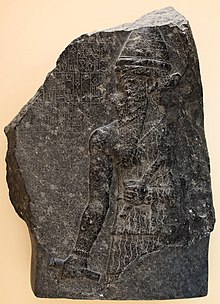 Portrait of Naram-Sin | |
| King of the Akkadian Empire | |
| Reign | c. 2254 – 2218 BC |
| Predecessor | Manishtushu |
| Successor | Sharkalisharri |
| Result | Shar-Kali-Sharri |
| Dynasty | Dynasty of Akkad |
| Father | Manishtushu |
Naram-Sin besides transcribed Narām-Sîn or Naram-Suen (Akkadian: 𒀭𒈾𒊏𒄠𒀭𒂗𒍪: DNa-ra-am DSîn, meaning "Honey of the Moon God Sîn", the "𒀭" being a silent honorific for "Divine"),[1] was a ruler of the Akkadian Empire, who reigned c. 2254–2218 BC,[2] and was the third successor and grandson of Rex Sargon of Akkad. Under Naram-Sin the empire reached its maximum strength. He was the commencement Mesopotamian king known to have claimed divinity for himself, taking the title "God of Akkad", and the first to claim the title "King of the 4 Quarters, King of the Universe".
Biography [edit]
Naram-Sin was built-in every bit a son of Manishtushu. He was thus a nephew of King Rimush and grandson of Sargon and Tashlultum. Naram-Sin's aunt was the High Priestess En-hedu-ana. To be fully correct, rather than Naram-Sin or Naram-Suen "in Old Akkadian, the proper name in question should rather be reconstructed equally Naram-Suyin (more precisely, /narām-tsuyin/) or Naram-Suʾin (/narām-tsuʾin/)".[3]
Reign [edit]
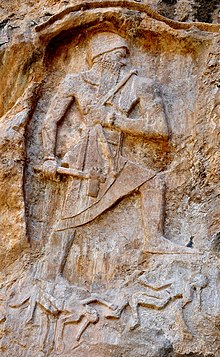
Naram-Sin defeated Manium of Magan, and various northern hill tribes in the Zagros, Taurus, and Amanus Mountains, expanding his empire up to the Mediterranean Sea and Armenia. His "Victory Stele" depicts his triumph over Satuni, principal of Lullubi in the Zagros Mountains. The king list gives the length of his reign as 56 years, and at least xx of his year-names are known, referring to military actions against various places such as Uruk and Subartu. One unknown year was recorded as "the Twelvemonth when Naram-Sin was victorious against Simurrum in Kirasheniwe and took prisoner Baba the governor of Simurrum, and Dubul the ensi of Arame".[v] Other year names refer to his construction piece of work on temples in Akkad, Nippur, and Zabala. He besides built authoritative centers at Nagar and Nineveh. At one point in his reign much of the empire, led by Iphur-Kis from the city of Kish rose in rebellion and was put downwards strongly.[vi]
Submission of Sumerian kings [edit]
The submission of some Sumerian rulers to Naram-Sin, and in general to the Akkadian Empire, is recorded in the seal inscriptions of Sumerian rulers such as Lugal-ushumgal, governor (ensi) of Lagash ("Shirpula"), circa 2230-2210 BC. Several inscriptions of Lugal-ushumgal are known, particularly seal impressions, which refer to him as governor of Lagash and at the time a vassal (𒀵, arad, "servant" or "slave") of Naram-Sin, too equally his successor Shar-kali-sharri.[7] [8] [9] [x] [11] One of these seals proclaims:
"Naram-Sin, the mighty God of Agade, king of the 4 corners of the world, Lugalushumgal, the scribe, ensi of Lagash, is thy servant."
It can be considered that Lugalushumgal was a collaborator of the Akkadian Empire, as was Meskigal, ruler of Adab.[13] Afterwards withal, Lugal-ushumgal was succeeded by Puzer-Mama who, every bit Akkadian power waned, achieved independence from Shar-Kali-Sharri, assuming the title of "King of Lagash" and starting the illustrious Second Dynasty of Lagash.[14] [15]
Control of Elam [edit]
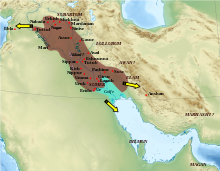
Naram-Sin campaigned from Elam in the east, to Ebla and Armanum in the w.
Elam had been under the domination of Akkad, at least temporarily, since the fourth dimension of Sargon.[16] The Elamite king Khita is probably recorded as having signed a peace treaty with Naram-Sin, stating: "The enemy of Naram-Sin is my enemy, the friend of Naram-Sin is my friend".[17] [xviii] [xix] It has been suggested that the formal treaty allowed Naram-Sin to have peace on his eastern borders, so that he could deal more effectively with the threat from Gutium.[17] Further study of the treaty suggests that Khita provided Elamite troops to Naram-Sin, that he married his daughter to the Akkadian king, and that he agreed to set up statues of Naram-Sin in the sanctuaries of Susa.[17] As a affair of fact, it is well known that Naram-Sin had extreme influence over Susa during his reign, building temples and establishing inscriptions in his name, and having the Akkadian linguistic communication supersede Elamite in official documents.[20]
During the rule of Naram-Sin, "armed forces governors of the country of Elam" (shakkanakkus) with typically Akkadian names are known, such as Ili-ishmani or Epirmupi.[21] [22] [23] [24] This suggests that these governors of Elam were officials of the Akkadian Empire.[21]
Conquest of Armanum and Ebla [edit]

Akkadian soldier of Naram-Sin, with helmet and long sword, on the Nasiriyah stele. He carries a metal vessel of Anatolian type.[25]
The conquest of Armanum and Ebla on the Mediterranean coast by Naram-Sin is mentioned in several of his inscriptions:[26]
"Whereas, for all time since the creation of flesh, no king whosoever had destroyed Armanum and Ebla, the god Nergal, by means of (his) weapons opened the way for Naram-Sin, the mighty, and gave him Armanum and Ebla. Further, he gave to him the Amanus, the Cedar Mountain, and the Upper Sea. Past means of the weapons of the god Dagan, who magnifies his kingship, Naram-Sin, the mighty, conquered Armanum and Ebla."
—Inscription of Naram-Sin. E 2.i.iv.26[26]
Nasiriyah stele of Naram-Sin [edit]
An alabaster stele representing captives being led past Akkadian soldiers is mostly attributed to Narim-Sin on stylistic grounds.[27] In detail, it is considered as more sophisticated graphically than the steles of Sargon of Akkad or those of Rimush.[27] Two fragments are in the National Museum of Republic of iraq, and one in the Boston Museum.[27] The stele is quite fragmentary, but attempts at reconstitution have been made.[28] [27] [29] Depending on sources, the fragments were excavated in Wasit, al-Hay district, Wasit Governorate, or in Nasiriyah, both locations in Republic of iraq.
Information technology is thought that the stele represents the result of the campaigns of Naram-Sin to Cilicia or Anatolia. This is suggested by the characteristics of the booty carried by the soldiers in the stele, especially the metallic vessel carried past the main soldier, the design of which is unknown in Mesopotamia, just on the reverse well known in contemporary Anatolia.[30]
-
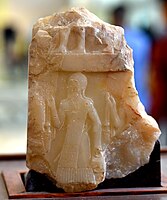
Soldier with sword, on the Nasiriyah stele of Naram-Sin
-

Naked captives, on the Nasiriyah stele of Naram-Sin
The Expletive of Akkad [edit]

Victory Stele of Naram-Sin, c. 2230 BC. It shows him defeating the Lullibi, a tribe in the Zagros Mountains, and their rex Satuni, trampling them and spearing them. Satuni, standing correct, is imploring Naram-Sin to salve him.[31] Naram-Sin is also twice the size of his soldiers. In the twelfth century BC it was taken to Susa, where it was institute in 1898.
| External video | |
|---|---|
 | |
 Victory Stele of Naram-Sin, Smarthistory Victory Stele of Naram-Sin, Smarthistory |
One Mesopotamian myth, a historiographic poem entitled "The curse of Akkad: the Ekur avenged", explains how the empire created by Sargon of Akkad vicious and the city of Akkad was destroyed. The myth was written hundreds of years subsequently Naram-Sin's life and is the poet's attempt to explain how the Gutians succeeded in conquering Sumer. Later on an opening passage describing the celebrity of Akkad before its devastation, the poem tells of how Naram-Sin angered the chief god Enlil past plundering the Ekur (Enlil's temple in Nippur.) In his rage, Enlil summoned the Gutians down from the hills due east of the Tigris, bringing plague, famine and decease throughout Mesopotamia. Food prices became vastly inflated, with the poem stating that 1 lamb would buy only half a sila (about 425 ml) of grain, half a sila of oil, or half a mina (nearly 250g) of wool.[32] To forbid this devastation, 8 of the gods (namely Inanna, Enki, Sin, Ninurta, Utu, Ishkur, Nusku, and Nidaba) decreed that the city of Akkad should be destroyed in order to spare the rest of Sumer and cursed it. This is exactly what happens, and the story ends with the poet writing of Akkad'southward fate, mirroring the words of the gods' expletive before on:
Its chariot roads grew nothing just the 'wailing institute,
Moreover, on its canalboat towpaths and landings,
No man walks because of the wild goats, vermin, snakes, and mountain scorpions,
The plains where grew the middle-soothing plants, grew nothing but the 'reed of tears,
Akkad, instead of its sweet-flowing water, there flowed bitter water,
Who said "I would dwell in that" found not a skillful dwelling place,
Who said "I would lie downward in Akkad" found not a skilful sleeping place.
Gutian Incursions [edit]
These Gutian raids were indeed devastating, but it is unknown how badly they afflicted Sumer. Naram-Sin may have passed on his empire to his son Shar-Kali-Sharri more or less intact upon his death in c. 2219 BC, or he may have passed on little more than Akkad itself.[33] The Gutians remained at that place for over 100 years before being replaced by the Ur 3 land as the ascendant political power.[34] [35]
Victory stele [edit]


Naram-Sin'southward Victory Stele depicts him as a god-king (symbolized past his horned helmet) climbing a mount higher up his soldiers, and his enemies, the defeated Lullubi led past their male monarch Satuni. Although the stele was broken off at the top when it was stolen and carried off by the Elamite forces of Shutruk-Nakhunte in the 12th century BC, it still strikingly reveals the pride, glory, and divinity of Naram-Sin. The stele seems to interruption from tradition by using successive diagonal tiers to communicate the story to viewers, however the more traditional horizontal frames are visible on smaller broken pieces. It is six feet and seven inches tall, and made from pink limestone.[36] The stele was found at Susa, and is now in the Louvre Museum.[37] A similar bas-relief depicting Naram-Sin was establish a few miles north-eastward of Diarbekr, at Pir Hüseyin.
The inscription over the head of the rex is in Akkadian and fragmentary, but reads:
"Naram-Sin the powerful . . . . Sidur and Sutuni, princes of the Lulubi, gathered together and they made state of war against me."
—Akkadian inscription of Naram-Sin.[38]
The second inscription, to the right over the mountainous cone, is in Elamite and was written about yard years later by rex Shutruk-Nahhunte, who stole the stele and brought it to Elam.[39]
Children [edit]
Among the known sons of Naram-Sin were his successor Shar-Kali-Sharri, Nabi-Ulmash, who was governor of Tutub, and a Ukin-Ulmash. Excavations at Tell Mozan (ancient Urkesh) brought to lite a sealing of Tar'am-Agade, a previously unknown daughter of Naram-Sin, who was possibly married to an unidentified endan (ruler) of Urkesh.[40] A recently found cylinder seal, looted from Urasagrig, shows that the governor at that place, Sharatigubishin, was as well a son.[41] Other known children include Enmenana, the high priestess at Ur, a son who was governor at Marad, two daughters who were ēntum-priestesses at Sippar and Nippur, Bin-kali-šarrē, Šumšani, Lipit-ilē, Rigmuš-ālsu, Nabi-Ulmaš, Me-Ulmaš, and Ukēn-Ulmaš. 1 girl, Tuṭṭanabšum, held the position of high priestess of Enlil at Nippur, the virtually important religious position in the empire. She was also deified, the but female and only non-king to be fabricated a god.[42]
In popular culture [edit]
King Naram-Sin is a graphic symbol in the 2021 video game House of Ashes, with the chief plot occurring in his personal temple.[43] In the game, he is the self-proclaimed "God King" of Akkad, and is engaged in a war with the Gutians later on beingness cursed by the god Enlil; whom he angered after the sacking his temple. Naram-Sin was voiced and move captured past Sami Karim.
Excavations by Nabonidus circa 550 BC [edit]


Extract describing the excavation
A foundation deposit of Naram-Sin was discovered and analysed past king Nabonidus, circa 550 BC, who Robert Silverberg thus characterises as the offset archaeologist.[44] Not only did he pb the kickoff excavations which were to find the foundation deposits of the temples of Šamaš the sun god, the warrior goddess Anunitu (both located in Sippar), and the sanctuary that Naram-Sin built to the moon god, located in Harran, merely he too had them restored to their old glory.[44] He was also the start to engagement an archaeological artefact in his try to date Naram-Sin's temple during his search for it.[46] His judge was inaccurate past about ane,500 years.[46] [44]
Inscriptions [edit]
-

Seals in the name of Naram-Sin
-
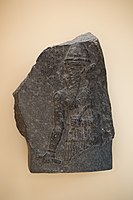
Stele of the Akkadian king Naram-Sin. The "-ra-am" and "-sin" parts of the name "Naram-Sin" announced in the broken top right corner of the inscription, traditionally reserved for the name of the ruler. Istanbul Archaeological Museum.
-
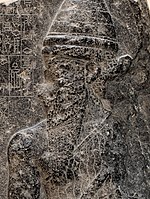
Portrait of Naram-Sin (detail)
-

The proper name "Naram-Sin" in cuneiform on an inscription. The star symbol "𒀭" is a silent honorific for "Divine", Sîn (Moon God) is specially written with the characters "EN-ZU" (𒂗𒍪).
-

Alabaster vase in the proper noun of "Naran-Sin, Rex of the four regions" '( 𒀭𒈾𒊏𒄠𒀭𒂗𒍪 𒈗 𒆠𒅁𒊏𒁴 𒅈𒁀𒅎
DNa-ra-am DSîn lugal ki-ibratim arbaim), limestone, c. 2250 BC. Louvre Museum AO 74.[48] -
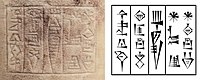
"Naran-Sin, King of the 4 regions" '( 𒀭𒈾𒊏𒄠𒀭𒂗𒍪 𒈗 𒆠𒅁𒊏𒁴 𒅈𒁀𒅎
DNa-ra-am DSîn lugal ki-ibratim arbaim), limestone, c. 2250 BC. Louvre Museum AO 74.[49] -

This bronze head traditionally attributed to Sargon is at present thought to really belong to his grandson Naram-Sin.[l]
-
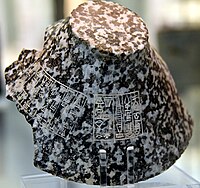
Fragment of a stone bowl with an inscription of Naram-Sin, and a 2d inscription by Shulgi (upside downwards). Ur, Iraq. British Museum.[51] [52]
-

Golden foil in the proper noun of Naram-Sin.
-
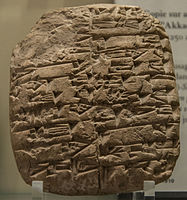
Re-create of an inscription of Naram-Sin. Louvre Museum AO 5475
-

Diorite base of statue of Naram-sin
-
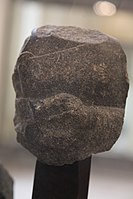
Fragment of a statue in the proper noun of Naram-Sin, Louvre Museum Sb 53
See besides [edit]
- Bassetki Statue
- History of Mesopotamia
- Sumerian king listing
- House of Ashes
References [edit]
- ^ Mémoires. Mission archéologique en Iran. 1900. p. 53.
- ^ heart chronology
- ^ Alkhafaji, N., & Marchesi, K. (2020). Naram-sin's state of war against armanum and ebla in a newly-discovered inscription from tulul al-baqarat. Journal of Nigh Eastern Studies, 79(one), 1. doi:http://dx.doi.org/x.1086/707663
- ^ Bromiley, Geoffrey Westward. (1995). The International Standard Bible Encyclopedia. Wm. B. Eerdmans Publishing. p. 186. ISBN9780802837851.
- ^ Twelvemonth-Names of Naram-Sin of Agade
- ^ Steve Tinney, A New Look at Naram-Sin and the "Bang-up Rebellion", Journal of Cuneiform Studies, vol. 47, pp. 1-xiv, 1995
- ^ "Sumerian Dictionary". oracc.iaas.upenn.edu.
- ^ a b Radau, Hugo (2005). Early Babylonian History: Downwards to the End of the Fourth Dynasty of Ur. Wipf and Stock Publishers. pp. 6–7. ISBN978-ane-59752-381-3.
- ^ Woolley, Leonard (1938). The Summerians. p. 83.
- ^ The Art Of Aboriginal Mesopotamia ( Art Ebook). p. 53.
- ^ Seal epitome M4 in: The Fine art Of Aboriginal Mesopotamia ( Art Ebook). p. 53.
- ^ "CDLI-Archival View RT 165". cdli.ucla.edu.
- ^ The Cambridge Ancient History. Cambridge University Printing. 1971. p. 436.
- ^ "Puzur-Mama, who served as a "governor" of Lagash, in all probability during the reign of Shar-kali-sharri. After the Akkadian empire had complanate, Puzur-Mama became fully independent, assuming the title of "King of Lagash"" in Álvarez-Mon, Javier; Basello, Gian Pietro; Wicks, Yasmina (2018). The Elamite Globe. Routledge. p. 254. ISBN978-1-317-32983-1.
- ^ The Cambridge Ancient History. Cambridge University Press. 1971. p. 998.
- ^ Gershevitch, I. (1985). The Cambridge History of Iran. Cambridge University Press. p. eight. ISBN978-0-521-20091-2.
- ^ a b c Edwards, I. Eastward. Southward.; Gadd, C. J.; Hammond, N. G. 50. (1971). The Cambridge Aboriginal History. Cambridge Academy Press. p. 651. ISBN978-0-521-07791-0.
- ^ Hansen, Donald P. (2002). Leaving No Stones Unturned: Essays on the Aboriginal Nigh East and Arab republic of egypt in Honor of Donald P. Hansen. Eisenbrauns. p. 233. ISBN978-1-57506-055-2.
- ^ "Site officiel du musée du Louvre". cartelfr.louvre.fr.
- ^ Edwards, I. E. S.; Gadd, C. J.; Hammond, North. M. 50. (1971). The Cambridge Ancient History. Cambridge Academy Press. pp. 444–445. ISBN978-0-521-07791-0.
- ^ a b Potts, D. T. (2016). The Archaeology of Elam: Formation and Transformation of an Aboriginal Iranian State. Cambridge Academy Press. p. 100. ISBN978-1-107-09469-vii.
- ^ "CDLI-Archival View". cdli.ucla.edu.
- ^ Álvarez-Mon, Javier (2020). The Art of Elam CA. 4200–525 BC. Routledge. p. 216. ISBN978-1-000-03485-1.
- ^ "Site officiel du musée du Louvre". cartelfr.louvre.fr.
- ^ McKeon, John F. X. (1970). "An Akkadian Victory Stele". Boston Museum Message. 68 (354): 239. ISSN 0006-7997. JSTOR 4171539.
- ^ a b Frayne, Douglas. Sargonic and Gutian Periods. pp. 132–133.
- ^ a b c d McKeon, John F. 10. (1970). "An Akkadian Victory Stele". Boston Museum Bulletin. 68 (354): 226–243. ISSN 0006-7997. JSTOR 4171539.
- ^ "CDLI-Archival View". cdli.ucla.edu.
- ^ Fine art of the First Cities: The Third Millennium B.C. from the Mediterranean to the Indus. Metropolitan Museum of Fine art. 2003. pp. 204–205. ISBN978-1-58839-043-1.
- ^ McKeon, John F. X. (1970). "An Akkadian Victory Stele". Boston Museum Message. 68 (354): 239. ISSN 0006-7997. JSTOR 4171539.
- ^ Roux, Georges (1995). La Mésopotamie. Essai d'histoire politique, économique et culturelle. Le Seuil. p. 141. ISBN9782021291636.
- ^ Samuel Noah Kramer (2010-09-17). The Sumerians: Their History, Culture, and Character. University of Chicago Printing. ISBN978-0-226-45238-8.
- ^ Samuel Noah Kramer (2010-09-17). The Sumerians: Their History, Civilization, and Character. University of Chicago Press. ISBN978-0-226-45238-8.
- ^ Budge, Due east. A. Wallis, Sir (2005). Babylonian Life and History. New York: Barnes & Noble. ISBN0-7607-6549-9. OCLC 63278058.
- ^ Reade, Julian (2000). Mesopotamia. British Museum Press. pp. 67–68. ISBN0-7141-2181-9. OCLC 43501084.
- ^ Kleiner, Fred (2005). Gardner's Art Through The Ages. Thomson-Wadsworth. p. 41. ISBN0-534-64095-8.
- ^ Louvre ( Arts and Compages). Köln: Könemann. 2005. ISBN3-8331-1943-8.
- ^ Babylonian & Oriental Record. 1895. p. 27.
- ^ Mieroop, Marc Van De (2015). A History of the Ancient Near E, ca. 3000-323 BC. John Wiley & Sons. p. 199. ISBN9781118718230.
- ^ Buccellati, Giorgio; Kelly-Buccellati, Marilyn (2002). "Tar'am-Agade, Daughter of Naram-Sin, at Urkesh" (PDF). In Al-Gailani Werr, Lamia (ed.). Of Pots and Plans. Papers on the Archæology and History of Mesopotamia and Syrian arab republic presented to David Oates in Honour of his 75th Birthday. London: Nabu. pp. 11–31. ISBN1897750625. Archived from the original (PDF) on 2 April 2015. Retrieved xviii March 2015.
- ^ Steinkeller, Piotr. "2 Sargonic Seals from Urusagrig and the Question of Urusagrig'due south Location" Zeitschrift für Assyriologie und vorderasiatische Archäologie, vol. , no. , 2021. https://doi-org.wikipedialibrary.idm.oclc.org/10.1515/za-2021-2001
- ^ Kraus, Nicholas Larry. "Tuṭṭanabšum: Princess, Priestess, Goddess" Periodical of Ancient Nigh Eastern History, vol. 7, no. 2, 2020, pp. 85-99
- ^ "The Dark Pictures Anthology: Business firm of Ashes Preview". The 6th Centrality (TSA). 27 May 2021. Retrieved 5 November 2021.
{{cite spider web}}: CS1 maint: url-condition (link) - ^ a b c d Silverberg, Robert (1997). Groovy Adventures in Archaeology. University of Nebraska Press. p. viii. ISBN978-0-8032-9247-5.
- ^ Kelly, Robert 50.; Thomas, David Hurst (2013). Archeology: Down to Earth. Cengage Learning. p. ii. ISBN978-1-133-60864-6.
- ^ a b Hirst, Thou. Kris. "The History of Archaeology Part 1". ThoughtCo.com. Retrieved April 5, 2014.
- ^ Hansen, Donald P. (2002). Leaving No Stones Unturned: Essays on the Ancient Near East and Egypt in Honor of Donald P. Hansen. Eisenbrauns. p. 233. ISBN978-1-57506-055-2.
- ^ "Site officiel du musée du Louvre". cartelfr.louvre.fr.
- ^ "Site officiel du musée du Louvre". cartelfr.louvre.fr.
- ^ McKeon, John F. X. (1970). "An Akkadian Victory Stele". Boston Museum Message. 68 (354): 237. ISSN 0006-7997. JSTOR 4171539.
- ^ British Museum G56/dc11 BM 118553
- ^ "CDLI-Found Texts". cdli.ucla.edu.
Sources [edit]
- Piotr Michalowski, New Sources apropos the Reign of Naram-Sin, Journal of Cuneiform Studies, vol. 32, no. four, pp. 233–246, (Oct., 1980)
- H.Due west.F. Saggs, The Babylonians, Fourth Printing, 1988, Macmillan Publishers Ltd.
- J. P. Naab, Due east. Unger, Dice Entdeckung der Stele des Naram-Sin in Pir Hüseyin, Istanbul Asariatika Nesriyati XII (1934)[1].
External links [edit]
 | Wikimedia Commons has media related to Naram-Suen. |
- Victory Stele of Naram-Sin
montanezspither90.blogspot.com
Source: https://en.wikipedia.org/wiki/Naram-Sin_of_Akkad
0 Response to "King Who Appeared as a God in Mesopotamian Akkadian Art"
Post a Comment